AURIS (e)
Acoustic Perception System
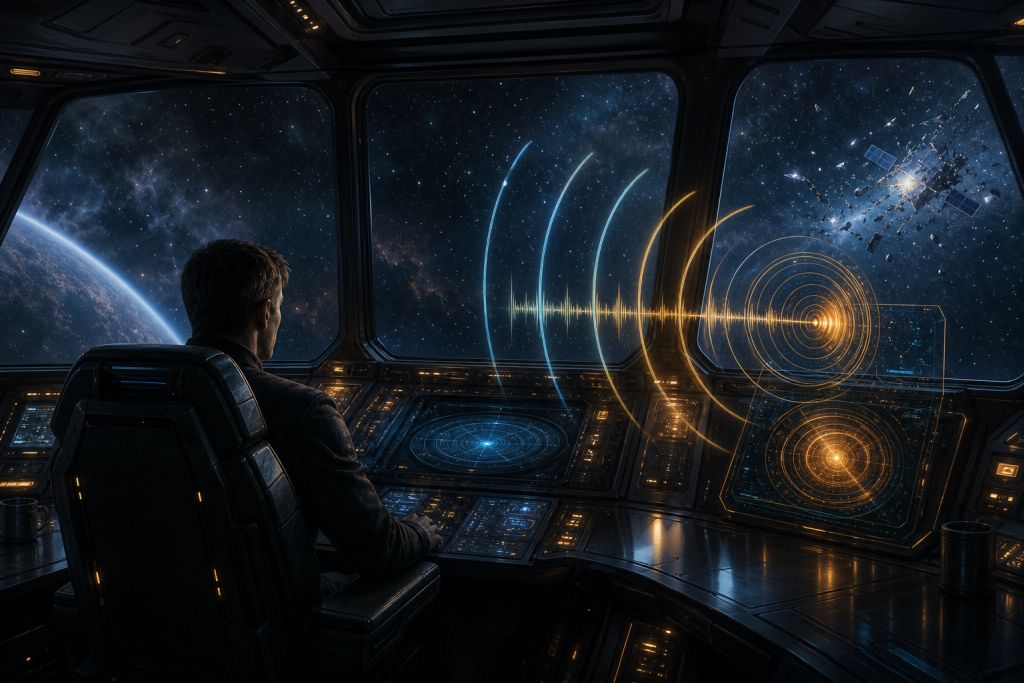
The Vacuum Is Silent. Your Operational Environment Is Not.
A recurrent criticism directed at prominent cinematic representations of spaceflight—particularly within the science-fiction genre—is the physically inaccurate depiction of acoustic propagation through interplanetary or interstellar vacuum. In the absence of a sufficiently dense material transmission medium, conventional pressure-wave propagation is, of course, impossible; consequently, an actual engagement between spacecraft would not acoustically resemble the spectacularly thunderous events traditionally presented by audiovisual entertainment media. Such representations deliberately suspend elementary physical constraints in order to increase dramatic intelligibility and maintain perceptual engagement—an especially conspicuous compromise in a genre whose technological premises frequently invite heightened scrutiny with respect to scientific plausibility.
The AURIS Acoustic Perception System, however, demonstrates that the absence of naturally propagating sound does not necessitate the absence of an acoustically intelligible environment.
AURIS has been in operational deployment for a sufficiently extended period that comparable principles of synthetic acoustic environmental representation may reasonably be assumed to have emerged independently in other technological contexts, civilizations, or historical epochs throughout the observable universe. The underlying rationale is straightforward: not only an external observer, but also the crew of a spacecraft benefits substantially from receiving complex environmental information through the highly developed spatial, temporal, and pattern-recognition capabilities of the human auditory system.
AURIS therefore does not attempt to detect sound propagating through vacuum. Instead, it performs a computationally mediated cross-modal transformation of externally measured physical phenomena into a spatially coherent synthetic acoustic representation.
The system integrates heterogeneous sensor information obtained from optical acquisition systems, active and passive radar, lidar assemblies, electromagnetic and field-sensitive instrumentation, and additional mission-specific sensor architectures. These independently acquired data streams are subjected to real-time multisensor fusion, probabilistic correlation, trajectory reconstruction, and comparison against an extensive database of known physical and technological signatures.
From this composite environmental model, AURIS synthesizes a dynamically updated three-dimensional auditory representation of the surrounding operational volume.
An external object therefore becomes acoustically perceptible not because a physical sound wave has traversed the intervening vacuum, but because its measurable signatures have been computationally translated into a predefined—or adaptively generated—acoustic signature profile. The resulting perceptual representation may encode parameters including relative bearing, angular displacement, estimated distance, translational and rotational motion, acceleration, propulsion state, energetic output, relative velocity, and the temporal evolution of the detected object.
In practical terms, the auditory field functions as a perceptual extension of the spacecraft's sensor architecture: directionally localized acoustic events correspond to spatially localized external phenomena, while modifications in spectral composition, amplitude, modulation, harmonic structure, temporal density, and apparent motion communicate changes in the underlying sensor-derived state.
AURIS is not restricted to the acoustic representation of artificial technological signatures.
Naturally occurring astrophysical and heliophysical phenomena may likewise be incorporated into the synthesized perceptual environment, provided that they produce quantifiable effects within the sensitivity range of the spacecraft's instrumentation. Measurements of ionizing radiation, electromagnetic flux, magnetic-field variation, plasma density, energetic particle transport, gravitational perturbation, and other relevant parameters can therefore be mapped onto specifically designed acoustic structures.
Elevated stellar activity, for example, may manifest as a fine, persistent, spectrally modulated crackling texture whose intensity and temporal density correspond to variations in measured particle and radiation flux. Coronal mass ejections, extreme magnetospheric disturbances, supernova-related emissions, or other high-energy astrophysical events may be assigned distinctly identifiable acoustic profiles whose perceptual characteristics evolve in accordance with their measured physical properties.
The result is not an arbitrary collection of cinematic sound effects, but a systematically generated auditory abstraction of measurable external reality.
Accordingly, the acoustic environment produced by AURIS encompasses substantially more than spacecraft, propulsion systems, weapons activity, or tactical engagements. It constitutes a continuously synthesized multisensory representation of the entire instrumentally observable environment surrounding the vessel.
The vacuum remains silent. AURIS makes its information audible.