V-Core (exE)
Vector Core Propulsion System
V-CORE represents a next-generation reactionless propulsion architecture engineered for the sustained generation, modulation, and vectorization of continuous translational acceleration across interplanetary and deep-space operational regimes.
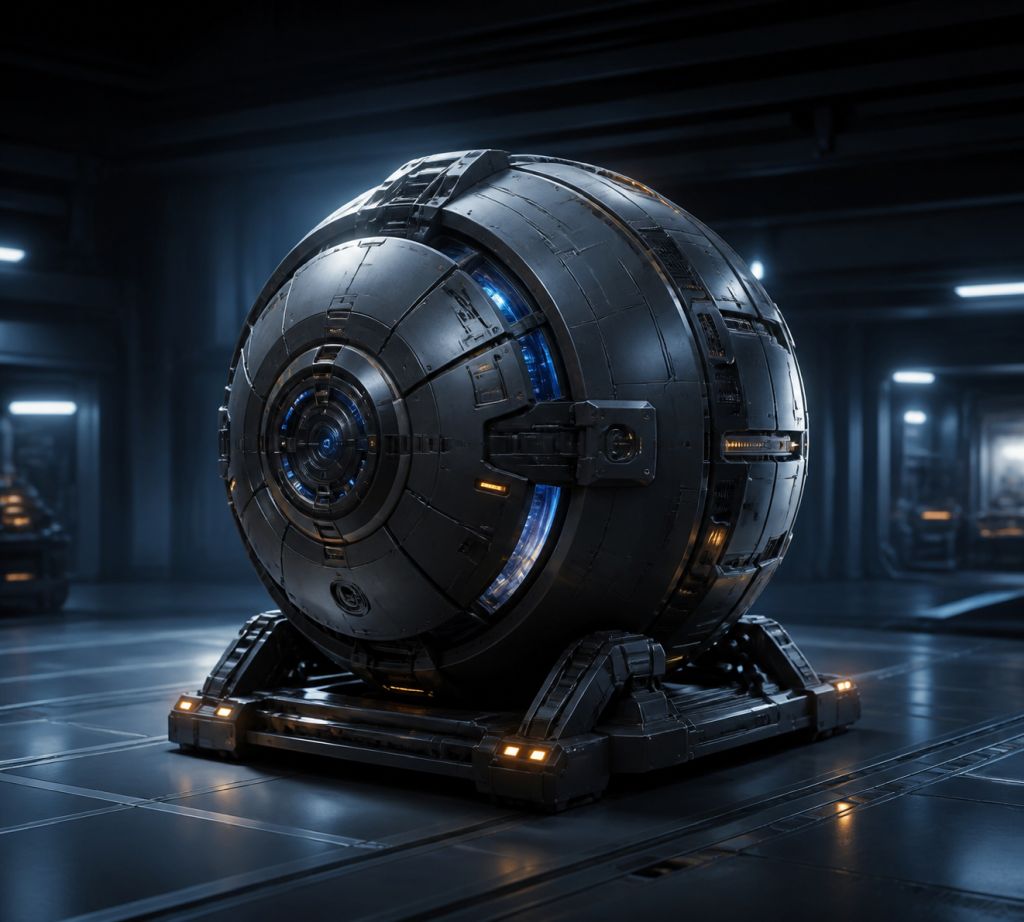
At the electromechanical and field-dynamic center of the system, phase-displaced inertial mass elements are driven through precisely synchronized, high-frequency motion sequences within a tightly regulated vector-coherence lattice. These oscillatory mass-state transitions are not utilized as conventional reaction elements; rather, their relative phase relationships are continuously manipulated in order to generate a controlled asymmetry within the local inertial coupling tensor.
Through this process, V-CORE establishes a macroscopically directed acceleration gradient without dependence upon conventional propellant expenditure, external reaction-mass ejection, or sustained momentum transfer to an exhaust stream*. The resulting vector-coupling regime effectively converts internally managed phase differentials into a persistent translational bias along a defined propulsion axis.
Real-time field processors continuously regulate phase offset, inertial synchronization, coupling amplitude, vector orientation, and structural compensation parameters across the active core assembly. This permits the propulsion field to be dynamically reshaped during operation, allowing seamless transition between primary acceleration, deceleration, trajectory refinement, station-keeping, and high-precision attitude-correction profiles without requiring mechanically independent thrust systems.
Depending upon installed core geometry, vessel mass distribution, available power architecture, and certified structural tolerances, V-CORE propulsion assemblies are capable of maintaining continuous acceleration levels of up to 1.5 G for extended operational periods.
Such sustained acceleration fundamentally alters conventional interplanetary mission architecture. Rather than relying upon brief high-energy burns followed by prolonged ballistic coast phases, V-CORE-equipped spacecraft may maintain controlled acceleration through substantial portions of the transit profile, followed by corresponding deceleration during terminal approach.
The resulting operational advantages include dramatically reduced transit durations, exceptionally fine trajectory control, continuous real-time course correction, reduced dependence upon narrow orbital transfer windows, and the establishment of a persistent onboard acceleration environment suitable for crewed long-duration operations.
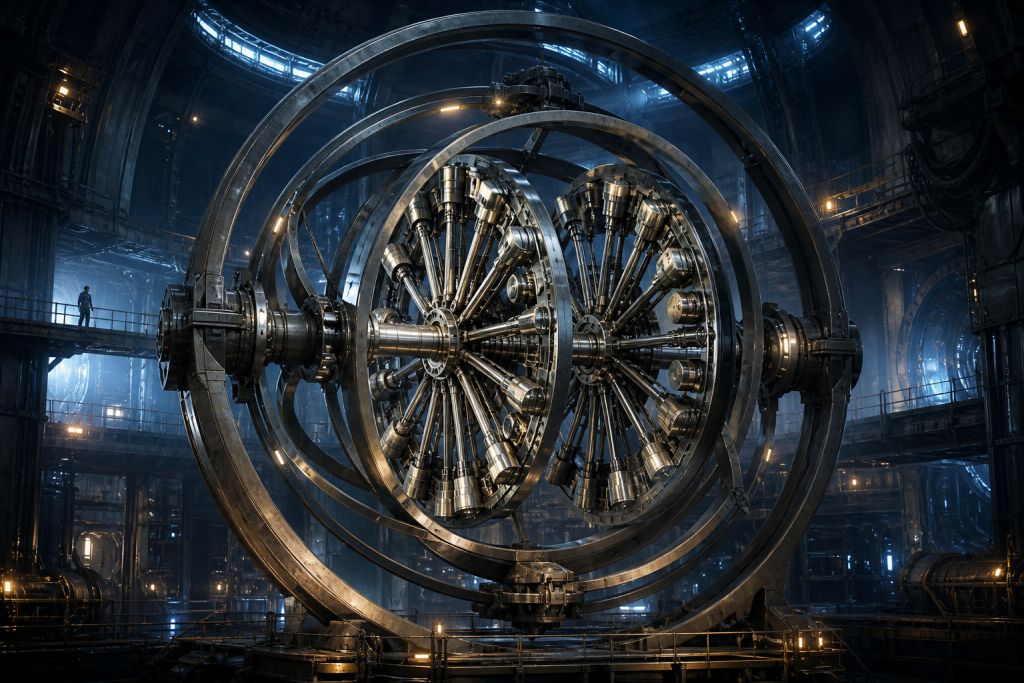
For crewed vessels, the propulsion system may additionally be integrated with the spacecraft's structural reference architecture so that the primary acceleration vector simultaneously functions as an artificial gravitational reference. Under nominal cruise conditions, habitation decks, workspaces, fluid systems, and internal logistics infrastructure may therefore be designed around a stable and continuously maintained acceleration field rather than intermittent thrust conditions or rotational gravity assemblies.
V-CORE does not merely propel the spacecraft.
It establishes a continuously controllable inertial reference environment around which the spacecraft itself may be designed.
V-CORE — Vectorized Acceleration Without Reaction-Mass Dependency.